

Nothing went wrong with the science. What went wrong was the sentence that comes after “FDA-cleared”: who pays for it. As of late 2022, only about 10 states and a handful of plans covered its products, and just 58% of the 31,000 prescriptions written in nine months were actually filled, per Medtech Insight.
The lesson I keep coming back to: an FDA authorization de-risks the science. It does not de-risk the business. The value gate is the reimbursement decision that lands months to years later, and it is a separate bet with separate odds.
That gap is finally getting policy attention. The Health Tech Investment Act (S. 1399), introduced in April 2025, would build a dedicated Medicare payment pathway for algorithm-based services, and CMS’s 2026 fee schedule started paying for digital mental health treatment devices outright.
If you underwrite the clearance as the inflection point, you are pricing the wrong milestone. Which milestone are you actually paying for?
Pear Therapeutics did everything the textbook asks. It won the FDA’s first De Novo authorization for a prescription digital therapeutic with reSET in 2017, went public in 2021 at a valuation near $1.6 billion, and built a clinically credible pipeline for substance use and insomnia. According to Fierce Biotech, it then filed for bankruptcy in April 2023 and sold its assets for roughly $6 million.
The science was never the problem. The problem was the sentence that comes after “FDA-cleared”: who pays. As Medtech Insight reported, by late 2022 only about 10 states, a few Blue Cross Blue Shield plans and SelectHealth covered any of Pear’s authorized products, and of the 31,000 prescriptions written in the first nine months of that year, just 58% were filled. A company can be scientifically validated by the most respected regulator in the world and still have no business, because clearance and coverage are two different decisions made by two different institutions on two different clocks.
That is the lens for this piece. In health tech, FDA authorization de-risks the science. It does not de-risk the business. The real value gate is the reimbursement decision that follows, and capital that treats the approval as the inflection point is buying the wrong milestone.
The milestone the market overweights
FDA authorization is a genuine event. It converts a research claim into a legally marketable product, and the market reacts hard to the surrounding uncertainty: Corcept shares fell about 50% in a single session on December 31, 2025 after a complete response letter for relacorilant, and Aldeyra dropped roughly 75% to $1.07 on March 17, 2026 after its reproxalap rejection, per PharmExec and RTTNews. Nobody should pretend the regulator is a formality.
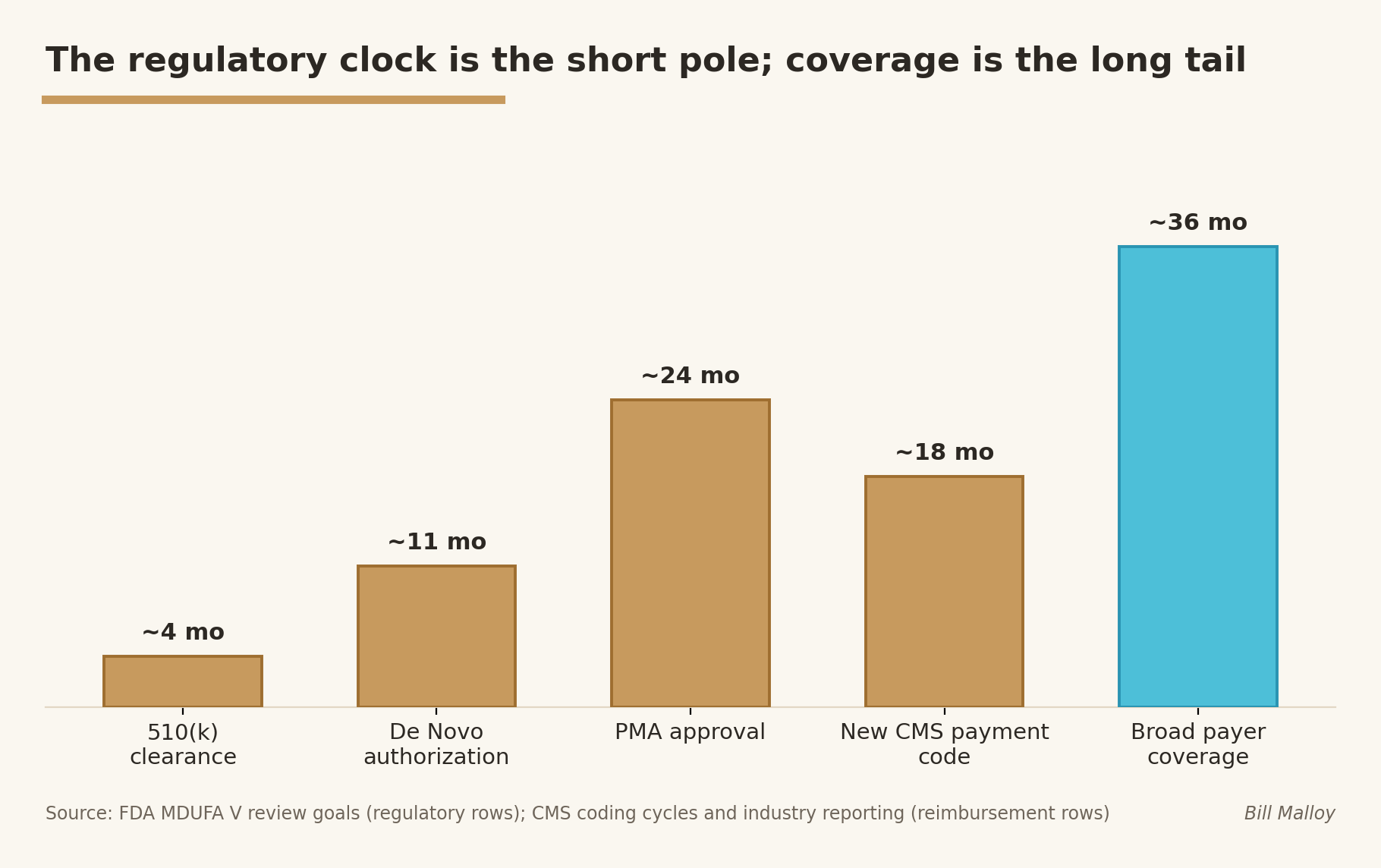
But notice what the authorization actually certifies. Under the FDA’s MDUFA V performance goals, the agency evaluates safety and effectiveness on defined clocks — roughly 90 review days for a 510(k), 150 for a De Novo, and about 285 for a premarket approval (PMA), which in practice means three-to-six months, ten-to-eleven months, and one-to-three years to market respectively, according to regulatory analysis from IntuitionLabs summarizing MDUFA V. A PMA program can run from about $500,000 to well over $5 million once clinical trials are included. All of that money and time buys one thing: permission to sell. None of it creates a customer who will pay.
And the supply of that permission is growing fast. A peer-reviewed taxonomy in npj Digital Medicine catalogued 1,016 FDA-authorized AI-enabled medical devices, about 76% of them in radiology, and the FDA’s own AI-enabled device list — last updated June 16, 2026 — keeps expanding, with 2025 the busiest year on record for AI clearances per Innolitics’ year-in-review. When authorizations are this plentiful and this concentrated, clearance stops being a differentiator. It becomes table stakes. The scarce thing is not FDA permission; it is a paid, repeatable claim.
Where value is actually created: the reimbursement gate
The reimbursement decision is where an approved product becomes an investable one, and it runs through machinery most technical diligence underweights. A device needs a billing code (a CPT or HCPCS code), a payment amount attached to that code, and then a coverage decision from Medicare and commercial payers who each decide, plan by plan, whether to reimburse. Each step is a separate approval with its own timeline, and a new category of product frequently starts with no code at all.
This is the gap the Pear story exposed, and it is finally drawing policy. The Health Tech Investment Act (S. 1399 in the Senate, H.R. 6197 in the House), introduced on April 9, 2025 by Senators Mike Rounds and Martin Heinrich per Congress.gov, would create a dedicated Medicare payment pathway for “algorithm-based healthcare services” delivered through FDA-authorized AI devices. As Morgan Lewis’s analysis describes it, the bill would establish a new ambulatory payment classification and guarantee five years of distinct reimbursement — an explicit attempt to stop approved AI tools from dying in the coverage gap.
Meanwhile the payer of last resort has already moved. In the CY2026 Medicare Physician Fee Schedule final rule (CMS-1832-F), CMS finalized payment for digital mental health treatment devices under HCPCS codes G0552 through G0554 and, per Holland & Knight’s analysis, expanded that framework to cover devices treating ADHD when they meet FDA special controls. That is the missing half of the Pear equation arriving four years too late for Pear: not just “is it cleared,” but “here is the code and the payment.”
The investable read follows directly. A company holding FDA authorization with no coding strategy is holding a permission slip, not a revenue line. A company that can show authorization plus an active coding pathway plus early payer coverage has cleared the gate that actually gates value.
Pathway choice is a reimbursement decision in disguise
Here is the second-order move that separates people who have lived this from people who have only read the org chart. The choice among 510(k), De Novo and PMA is usually framed as a regulatory-speed decision. It is really a reimbursement decision wearing a regulatory costume.
A 510(k) clears by demonstrating substantial equivalence to an existing device — which often means the product inherits an existing billing code and an established payment rate along with its predicate. A De Novo, by design, creates a brand-new device category where no predicate exists. That sounds like a moat, and in regulatory terms it is. But a new category also means no existing code and no established payment amount, so the company must build reimbursement from zero — petition for a code, wait for a rulemaking cycle, and negotiate coverage plan by plan. The pathway that gives you the cleanest regulatory story can hand you the hardest revenue problem. Pear’s De Novo made it a pioneer and left it a category of one that payers had no habit of paying for.
The insider tell, then, is not whether a company has filed with the FDA. It is whether it has a coding and coverage plan dated *before* the clearance — a reimbursement dossier, health-economic evidence built for payers rather than reviewers, and ideally a code application already in motion. Founders who have been through it quietly fear the new-category win precisely because it resets the payment clock to zero. When a management team can walk you through their CPT timeline as fluently as their clinical endpoints, that is the signal. When they can only talk about the submission, they are telling you which milestone they think they are selling.
The strongest case against this view
The serious counterargument is that clearance really is the value inflection, and reimbursement is a downstream detail that sorts itself out. Its evidence is real. The CRL reactions above show the market treating the regulatory decision as the moment risk resolves. A De Novo or PMA can build a durable regulatory moat: a competitor cannot simply file a cheap 510(k) against a predicate that does not exist, so first authorization in a new category can lock out fast followers for years. And for diagnostics and imaging AI that ride existing radiology codes, clearance genuinely does open a near-term revenue path, which is part of why 76% of authorized AI devices cluster there.
That case is strong exactly where the product slots into existing payment plumbing. It is weak everywhere the product creates something new — a novel therapeutic mechanism, a new site of care, a service Medicare has never priced. In those cases the regulatory moat is real and the revenue is still absent, which is precisely the Pear configuration: a defensible category with no one obligated to pay for it. A moat around a market that does not yet reimburse you is a moat around an empty field. The steelman is right that clearance is *an* inflection. It is wrong that it is *the* inflection whenever the product cannot borrow an existing code.
What I’d watch — and what would change my mind
Here is the honest tension. My thesis assumes the reimbursement gate stays roughly as high and as slow as it has been, and policy is actively trying to lower it. If the Health Tech Investment Act becomes law and CMS keeps standing up codes like G0552–G0554 for whole categories, the lag between clearance and coverage could compress from years toward months — and the gate I am describing would narrow. That is the scenario in which “FDA clearance de-risks the science, not the business” ages into a period-piece observation rather than a durable one.
So here is the falsifiable call. Over the next 24 months, I expect the market to keep punishing FDA-cleared digital-health and novel-device companies that lack a coding-and-coverage path — through down rounds, distressed sales, or shutdowns — at a visibly higher rate than cleared companies that ride existing reimbursement. The metric I would track is the spread in survival and follow-on financing between those two groups. What would change my mind: passage of the Health Tech Investment Act with a funded payment classification, plus CMS extending category-level payment beyond mental health, such that a clearly identifiable cohort of new-category cleared products reaches broad payer coverage within roughly a year of authorization. If clearance-to-coverage collapses to that timeline, reimbursement stops being a separate gate and the two milestones effectively merge.
Until then, the discipline is unglamorous and specific: read the reimbursement dossier before the regulatory one, treat a De Novo as a coding project rather than a victory lap, and price approval as what it is — the end of the science risk and the opening bell of the business risk. This is analysis, not investment or medical advice. But the pattern is stable enough to name: in health tech, the FDA tells you the thing works. The payer tells you whether it is a company.
Sources
Fierce Biotech — Pear Therapeutics bankruptcy, ~$1.6B valuation and asset sale
Medtech Insight (Citeline) — Pear coverage, prescriptions filled, payer count
npj Digital Medicine (Nature) — taxonomy of 1,016 FDA-authorized AI devices, radiology share
FDA — Artificial Intelligence-Enabled Medical Device List (updated June 16, 2026)
Innolitics — 2025 Year in Review: AI/ML Medical Device 510(k) Clearances
IntuitionLabs — FDA SaMD pathways: 510(k), De Novo & PMA timelines and costs (MDUFA V)
Congress.gov — S.1399, Health Tech Investment Act, 119th Congress
CMS — CY 2026 Medicare Physician Fee Schedule Final Rule (CMS-1832-F) fact sheet
PharmExec / RTTNews — CRL stock reactions: Corcept and Aldeyra